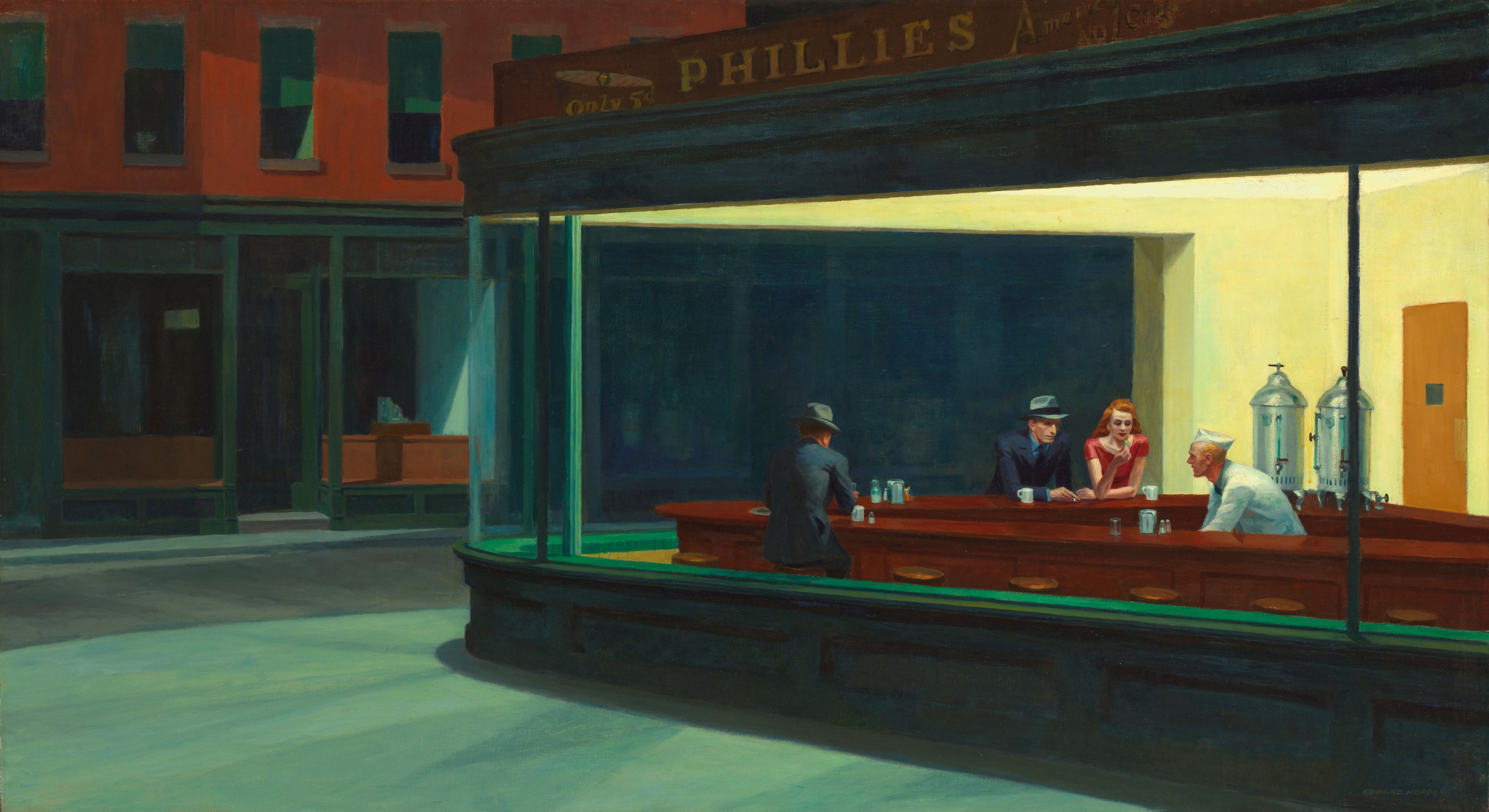
Edward Hopper 《Nighthawks - The Solitude of the Night
Quote
"I often in imagination set up my easel before interesting building or structure and go through the process of doing the painting."
— Edward Hopper
Introduction
Have you ever experienced that strange solitude of late night, where time seems to stop and the world feels infinitely distant? Visit Masterpiece Gallery and encounter one of art's greatest masterpieces expressing the melancholy of urban isolation.
Into the Painting
A fluorescent-lit diner glows like an island in the darkness of night. The interior is filled with an artificial yellow-green light that spills onto the empty street outside. The diner's large windows are transparent, allowing us to observe the interior scene as if we were voyeurs. Inside, a few figures sit separately, each absorbed in their own solitude. A waitress in a red dress stands behind the counter, her posture suggesting not joy nor despair, but rather a kind of professional numbness. A man in a dark suit and fedora sits at the counter, gazing down at his coffee cup. Another young couple sits in a booth, a strange silence hovering between them. On the left, a man approaches from the street, seemingly preparing to enter. The architectural style of the diner is unmistakably American—the red and green exterior, the Phillips sign partially visible above, the geometric simplicity of the structure. Beyond the fluorescent light's reach, the street lies completely empty and dark. No other people, no cars, no signs of life. It is as if time has frozen at this moment, as if the world has abandoned everything except this single diner.
The Birth of Loneliness Within the American Dream
Edward Hopper painted this work in 1942 during World War II. Yet the war feels distant from this canvas. Instead, what dominates is a peculiarly American loneliness. Hopper was born in 1882 in Nyack, New York, and spent most of his life in New York City. He was fascinated by ordinary American architecture and everyday scenes. But unlike other American regionalist painters who celebrated the vitality of their nation, Hopper was drawn to emptiness and silence. He had no interest in celebrating America; his interest lay in capturing its hidden melancholy. Nighthawks, painted in 1942, represents one of his most iconic explorations of this theme. The diner in the painting was inspired by actual diners Hopper had observed in New York. Yet it is not a specific place; rather, it is a universal space—any diner, anywhere in America, at any late hour.
The Geometry of Loneliness
What immediately strikes one about Hopper's work is his use of geometry. The lines are clean, the angles precise, and the perspective mathematically exact. This is not the loose, expressive geometry of modernism. Rather, it is the cold, rational geometry of industrial America. The diner is composed of horizontal and vertical lines, creating a sense of confinement and isolation. The large window functions as both barrier and frame, separating inside from outside, light from darkness. The fluorescent light creates a zone of visibility, but it also creates a boundary. Those inside cannot easily see out into the darkness, nor can those outside easily see in. This architectural separation becomes a visual metaphor for emotional distance between people. Notice how even the two people sitting together in the booth do not look at each other. They are physically close yet spiritually distant. The waitress, despite being surrounded by customers, is profoundly alone. The man at the counter, hunched over his coffee, is lost in his own thoughts. And the figure approaching from the street remains outside, excluded from the scene, observing from the darkness.
The Color of Alienation
Hopper's palette in this painting consists primarily of warm tones—the yellow of the fluorescent light, the red of the waitress's dress, the brown of the wooden counter—contrasted with the cool tones of the night outside. This color contrast is not accidental. The warm colors of the interior suggest comfort and shelter, yet they feel artificial and isolating. The fluorescent light is not the warm glow of a fireplace or candlelight; it is the cold, industrial illumination of modernity. The red of the waitress's dress, which should suggest vitality and life, instead creates a sense of alienation. She stands out against her surroundings precisely because of her isolation. The cool greens and dark blues of the exterior suggest the vast, indifferent universe that surrounds this small bubble of human presence. This color scheme perfectly captures the emotional essence of Hopper's vision—the paradox of being surrounded by comfort while feeling utterly alone.
The Modern Condition Captured in a Moment
Nighthawks has become an iconic representation of American modernism and the alienation it produces. In the early twentieth century, America was experiencing rapid urbanization and industrialization. Cities grew, populations increased, yet paradoxically, people felt more isolated than ever. Traditional communities and social structures were breaking down. In their place arose the anonymous urban landscape—the diner, the hotel, the office building—spaces where strangers gathered without truly connecting. Hopper understood this new condition and painted it with unflinching honesty. His figures are not dramatic or emotionally expressive. They simply exist in their isolation. The waitress performs her job. The customers consume their coffee. The street remains empty. Life continues without passion or meaning. Yet there is a strange beauty in this bleakness. The careful composition, the precise use of light and shadow, the psychological depth—all these elevate the mundane scene to the level of tragedy. In capturing the ordinary, Hopper captures something profound about the human condition.
Points of Appreciation
① Composition — The diner is positioned off-center, creating an asymmetrical balance. The large window dominates the composition, emphasizing the separation between inside and outside, light and darkness.
② Color and Light — The contrast between the artificial warmth of the interior and the cold darkness of the exterior is the heart of the painting's emotional power. Notice how the fluorescent light creates a sense of unreality.
③ Perspective — Hopper uses one-point perspective to draw the viewer's eye into the diner. We are positioned as voyeurs, observing a scene we cannot fully understand or participate in.
④ Emotion — What makes this painting so powerful is its restraint. There is no melodrama, no explicit statement of emotion. Yet the loneliness is palpable. You feel the silence, the distance, the disconnection.
About the Artist
Edward Hopper | 1882-1967
An American realist painter best known for his depictions of contemporary American life. Hopper's work is characterized by sharp, clean lines, dramatic use of light and shadow, and a focus on scenes of urban isolation. Though active for over sixty years, his most celebrated works were produced in the 1930s and 1940s. His paintings have become iconic representations of American modernism and continue to influence artists and filmmakers worldwide.
Nighthawks | 1942 | 84 × 152 cm | Art Institute of Chicago
Discussion Room 💬
What did you feel when observing Hopper's late-night diner?
① 🌙 A profound sense of solitude
② 💭 Recognition of your own loneliness
③ 🪟 Fascination with the boundary between observer and observed
④ 🎨 Appreciation for the beauty of emptiness
Share your reflections in the comments! 💕
Closing
✨ Visit Masterpiece Gallery for more remarkable stories about paintings! ✨
New masterworks and their hidden stories are updated weekly. Subscribe now and discover the paintings that awaken your sensibility first. Masterpiece Gallery is a community where we appreciate art together, not alone.
▶️ https://masterpiece-gallery.tistory.com/
Hashtags
#EdwardHopper #Nighthawks #AmericanRealism #Modernism #MasterpieceGallery #ArtAppreciation